Tuesday, 28 January 2014

George Couros' 5 great reasons to create an online portfolio... just in the nick of time!

Why create an online portfolio? Who better to take notes from than Mr. George Couros?!  Just as I was contemplating why I should spend countless hours creating a professional online portfolio, I came across this blog from George: 5 Reasons Your Portfolio should be online. Talk about perfect timing!! For those of my classmates who are short on time and contemplating creating their own online portfolios, here's what George has to say in a nutshell!

  1. The Google Factor: A digital portfolio means a digital footprint! As future educators it is important that we have a positive online presence and teach our students to create the same!
  2. Searching and Organization: Rather then flipping through a large paper binder, fellow teachers and employers can easily navigate though your online portfolio and quickly find what they are looking for.
  3. Anywhere, any place and any time access: This point is all about convenience. Don't have that portfolio binder on hand? No problem, here's the link!
  4. Creating Opportunities instead of looking for them:  It's important to remember that the thoughts and ideas you have are unique and may be very useful to others. When you publish your work online, anyone can view it, connect with you, and as a result, opportunities may come knocking. Aren't you glad you clicked, "Share?!" :)
  5. Continuous Learning: George encourages us to, "look at online portfolios as both a way to "showcase" and "learn."" The process of creating a portfolio is a great way to solidify ones ideas, beliefs and philosophy surrounding education. As future teachers this is a very important process for us to go through. 
For the full version of George's 5 reasons to create an online portfolio, check out the link posted above. Good luck everyone and stay tuned for the publishing of my online portfolio... this slight perfectionist better get to work! ~T

Monday, 20 January 2014

Shelley Wright: An inspirational Inquiry-Based Teacher


I have just realized  a new reason to love blogging! In my previous post, I shared some thoughts I had on inquiry-based learning and expressed my interest in continuing to learn about this teaching style. One of my professors, Mike Nantais read my post and suggested that I follow Shelley Wright's blog, a high-school teacher from Moose Jaw, SK. So I've read through some of her blogs and watched the above video, and as a result I have been left feeling so inspired! Not only am I inspired by Shelley and her students, but I'm also inspired by blogging. If it hadn't been for my previous post, I may have never been able to learn from Shelley, and hopefully connect with her in the future.

"Our students will exceed our expectations of them, if we only give them the opportunity." I love this quote from Shelley in the above video. As adults, I think many of us are guilty of limiting young people with our expectations. We tend to be more rational, logical and realistic. However, kids aren't like that, and when given the opportunity, they can do amazing things. Shelley's video is a great example of that. If you are also interested in inquiry-based learning, I recommend following Shelley Wright's blog.

Have a great day! ~ T

Wednesday, 15 January 2014

A Return to Blogging and my thoughts on Inquiry

Well, the last time I blogged was at the end of the "Internet for Educators," course last year. While I enjoyed organizing my thoughts through the process of blogging, and had good intentions to continue throughout other classes and student teaching placements, my blog seemed to fall lower and lower on my list of priorities, and was eventually forgotten. That was until the course, "Using ICT in Education," started again this January. My classmates and I were given the option to blog once a week, or come up with a summative assignment capturing the learning that took place throughout the course at the end of the term. Choosing to blog was an easy choice for me, as I find it helps me through the learning process. I hope that this time I will be able to stick with it and blog throughout my final student teaching placement and into my teaching career. I think blogging is a beneficial practice for all teachers.

The illustration I created above, using "tagxedo.com," is a reflection of my brainstorming that took place when thinking about technology and its many uses. There is one word that I find especially meaningful. This word is, "Inquiry." Lately I have been learning about inquiry circles, and  the inquiry process through the science curriculum. The idea of having an inquiry based classroom has totally shifted the way I feel about teaching. We have talked a lot about how we were taught in the past. The classroom was teacher-led and the teacher gave you all the information for each subject. Students crammed for tests to regurgitate this information. No wonder school sometimes felt like a drag, instead of an exciting place of learning. As future teachers, we are now being taught to teach through inquiry, and allow our classrooms to be more student-led. Instead of "teaching" and providing students with material, we are instead facilitators of learning, as well as co-learners with our students. We provide our students with ways to find the answers to their questions. I feel that researching through various forms of information to find answers is such a useful skill for students to have in this modern day society where information is held at everyone's fingertips. I also think it's important for students to be taught how to properly research on-line. An inquiry-based classroom is an engaging one, where meaningful learning takes place. I look forward to furthering my knowledge in this area, and teaching more through inquiry in my final student teaching placement. A great resource from which I've been learning about Inquiry Circles, is the book: "Comprehension and Collaboration: Inquiry Circles in Action," written by Stephanie Harvey and Harvey Daniels. This book is very helpful in learning how to implement Inquiry Circles into your classroom and I highly recommend it. Until my next blog.... ~T

Saturday, 9 March 2013

The end of another term, and a final "I4Ed" post

The end of another term is upon us, and that means the end of "Internet for Educators," blog posts. But I plan to continue blogging as I have found that I really enjoy it. It's a great way to track my learning and share it with others. So as I am inspired with new knowledge, I plan to keep up with this blog in the future. :) I have really enjoyed the I4Ed course and am thankful for all the connections I have made. It felt great to be pushed out of my comfort zone in the world of technology. Although it was difficult figuring out some things in the beginning, I now see the benefits of all that was accomplished in this course.

Thank you Mike Nantais, guest speakers, and fellow classmates for a being a part of this great learning experience. I have attached my final project for the term in the link below. It is a review of some of the many things I have learned in this course. ~T

Summative Project

Thursday, 7 March 2013

Infographics....Information visually displayed using graphics?

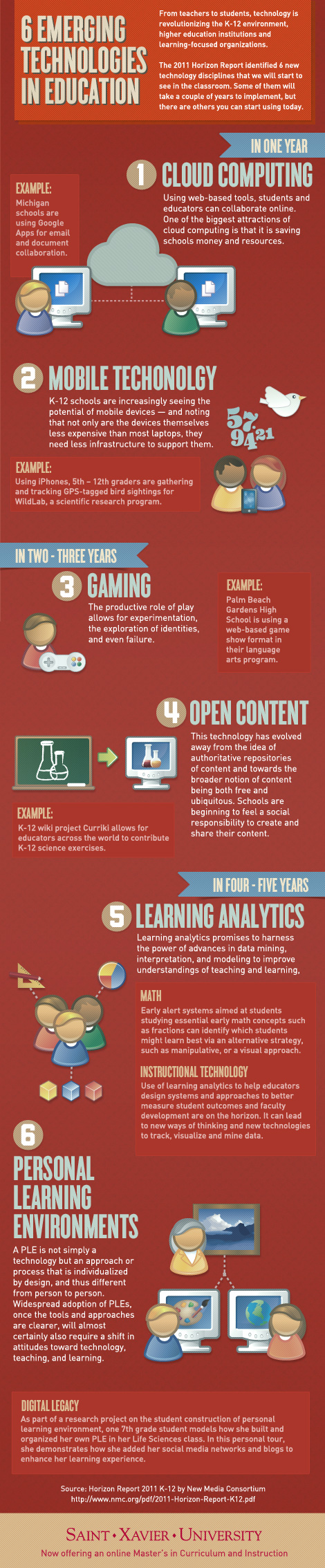
6 Emerging Technologies in Education Infographic

After researching and looking at infographics, I found this one on the 6 Emerging Technologies in Education. <--- My last post happened to be on this topic and I must say that the same information presented in this way is so much more visually appealing than the super long blog I wrote about it. There in-lies the purpose of infographs: To provide a visual representation of information in a quick, clear and visually appealing manner.

Infographics could be very useful in the classroom. When teaching information that may be difficult to understand, infographics provide a visual component to make understanding easier. Although infographics are time consuming to make, once you have made them you have them forever and can share them with others.

The infographic that I made was on "The life of a hashtag." The hashtag I chose to use is the one that we have been using in this course: I4Ed. --->

Conclusion: +Tyler Letkeman wooped us. Thanks for tweeting Tyler! ~T

Sunday, 3 March 2013

What's next? What does the future hold for education?


The field of education is one that is continuously evolving, growing, changing, moving forward etc.,... Bottom line: It is very dynamic! When looking ahead to the future of education, we should continue to expect change. This is one of the things I love about my future career! I love learning new things and know that I will always be challenged to learn and grow as an educator in this field. I could not be more excited about the knowledge I will obtain in my teaching years and pass on to my students.

Education has been a dynamic field before the introduction of technology in the classroom. However, technology has expanded education and created a great deal of change in the classroom in a short period of time.  Allow me to use my K-12 education as an example. When I first started school, teachers used blackboards, then upgraded to white boards, and now it is rare to find a classroom that does not have an interactive Smart Board.  I should also mention that there was no access to computers in my early years classroom, which then gave way to having a few of the huge dinosaur (and very slow) computers in my middle years classroom (which we used for the sole purpose of improving our typing skills). Flash forward to classrooms today and you will find IPads, IPhones, IPods, netbooks and laptops available for students use. Does anyone else remember those awful overhead projection machines that were impossible to see around, or the sound of the TV stand wheels coming down the hallway to enter your class so you could watch a video? I’m not sad at all that those days are gone. 

It is clear that with technology education has already come very far. But what is next? What does the future hold for education? After reading the K-12 Horizon Report, I think it is safe to say that emerging technologies will continue to have a great impact on the education field. So what can we expect for the future? The K-12 Horizon Report names 6 technologies to watch for.

The first is Cloud Computing: “The emergence of very large “data farms” — specialized data centers that host thousands of servers — has created a surplus of computing resources that has come to be called the cloud. Growing out of research in grid computing, cloud computing transforms once-expensive resources like disk storage and processing cycles into a readily available, cheap commodity. Development platforms layered onto the cloud infrastructure enable thin client, web-based applications for image editing, word processing, social networking, and media creation” (Johnson, L.,Adams,S.,and Haywood,K., p.10).

The second is Mobiles. “It is no arbitrary decision that the statistical point of comparison is between new lives and mobiles; the next generation of students will inevitably be armed with smarter mobiles at younger ages. Perhaps even more important for education is that Gartner Research projects Internet-capable mobile devices will outnumber PCs by 2013. In Japan, over 75% of Internet users already use a mobile as their first choice for access. This shift in the means of connecting to the Internet is being enabled by the convergence of three trends: the growing number of Internet-capable mobile devices, increasingly flexible web content, and continued development of the networks that support connectivity” (Johnson, L., Adams, S., and Haywood, K., p. 14).

The third is Game-Based Learning. “Developers and researchers are working in every area of game-based learning, including games that are goal-oriented; social game environments; non-digital games that are easy to construct and play; games developed expressly for education; and commercial games that lend themselves to refining team and group skills. Role-playing, collaborative problem solving, and other forms of simulated experiences are recognized for having broad applicability across a wide range of disciplines” (Johnson, L., Adams, S., and Haywood, K., p. 18).

The fourth is Open Content. “The movement toward open content reflects a growing shift in the way academics in many parts of the world are conceptualizing education to a view that is more about the process of learning than the information conveyed in their courses. Information is everywhere; the challenge is to make effective use of it. Open content embraces not only the sharing of information, but the sharing of instructional practice and experiences as well. Part of the appeal of open content is that it is also a response to both the rising costs of traditionally published resources and the lack of educational resources in some regions. It presents a cost-effective alternative to textbooks and other materials” (Johnson, L., Adams, S., and Haywood, K., p.22).

The fifth is Learning Analytics.Learning analytics refers to the interpretation of a wide range of data produced by and gathered on behalf of students in order to assess academic progress, predict future performance, and spot potential issues. Data are collected from explicit student actions, such as completing assignments and taking exams, and from tacit actions, including online social interactions, extracurricular activities, posts on discussion forums, and other activities that are not directly assessed as part of the student’s educational progress. The goal of learning analytics is to enable teachers and schools to tailor educational opportunities to each student’s level of need and ability. Learning analytics promises to harness the power of advances in data mining, interpretation, and modeling to improve understandings of teaching and learning, and to tailor education to individual students more effectively” (Johnson, L., Adams, S., and Haywood, K., p. 26).

The sixth is Personal Learning Environments. “Personal learning environments (PLEs) are often described as systems for enabling self-directed and group-based learning, designed around each user’s goals, with great capacity for flexibility and customization. PLEs are conceived as drawing on a variety of discrete tools, chosen by the learner, which can be connected or used in concert in a transparent way. While the concept of PLEs is still quite fluid, it does seem to be clear that a PLE is not simply a technology but an approach or process that is individualized by design, and thus different from person to person”(Johnson, L., Adams, S., and Haywood, K., p. 30).

These six technologies to watch for are listed in order of expected chronological emergence. Some schools are already embracing cloud computing and mobiles. Schools are moving in the direction of having a “Bring your own device,” policy for their classrooms. I found reading the K-12 Horizon Report to be very beneficial. The more knowledge you have about upcoming changes, the more you can prepare yourself to be ready for them. If you are interested in reading this report and learning more about these six emerging technologies and the future of education, you can find it here: K-12 Horizon Report. Happy Reading! ~T

Johnson, L.,Adams,S.,andHaywood,K.,(2011).TheNMC Horizon Report: 2011 K-12 Edition.Austin,Texas:TheNew MediaConsortium.

Our turn to speak: Group Presentation Week!


This past week in I4Ed we did not have a speaker. Instead, we were given the opportunity to work in groups and research a current internet topic in education, and present our findings to the class. First, I must say that I really enjoyed each of the presentations. They were all informative and everyone did a great job!

My group was the first to present. Our topic was on “Bring Your Own Device” (BYOD). Schools are starting to movie in this direction and we were interested in learning more about it. We researched the different devices available for student use (there are many), the statistics around BYOD, the variety of available apps that could be used in a BYOD classroom (again...there are many), the policies for BYOD and the benefits and risks of BYOD. To view all of the information we found, please see our presentation!

The second group to present talked about, "The Good, the Bad, and the Ugly of the internet." The Good: The internet provides students and teachers with quick access to information, and the ability to contact and network with people all over the world. The internet allows teachers to bring the world into their classrooms, and not to mention the millions of resources available to teachers and students online. The Bad: The internet is a great tool... unless it used inappropriately. It is much easier for students to plagiarize today with a simple “copy and paste,” off the internet. Teachers need to be extra cautious of this. The internet also provides students with the opportunity to post any words or pictures online. Young people do not always use their discretion when posting and do not realize the consequences of their online actions. This can get them into trouble. The internet has also formed a new and easy way for bullying to take place. Cyber bullying is another issue  teachers should be aware of and on the lookout for. Lastly, there is credible and non-credible information available on the internet. Teachers need to warn students about non-credible information and teach them how to distinguish it from credible information. The Ugly: The ugly side of the internet includes things like cyber harassment/ bullying, black mailers/predators, and job losses due to inappropriate digital footprints. This last point is so important. As educators, we need to inform our students that their online actions can stay with them for life. Future employers are likely to Google candidates to see if they are right for the job. It’s important to think before your post. To see this groups presentation: click here.

The third groups presentation was called, “How not to steal from the internet.” This was a very informative presentation. I realized how I unknowingly have been guilty of stealing from the internet by not attributing a picture that I used to its owner, or the same with videos, etc. Although I have been lucky so far, the consequences for these actions could be great. So as a teacher, we need to warn and educate our students about how not to steal from the internet. One of the best ways to do this is through modelling. Attribute all of your pictures and videos etc., in your presentations to the class, and educate and expect the same from your students.  To see the website that this group made, visit this website.

The fourth group also had an interesting topic on “Internet Filters.” Internet filters serve a great purpose. They prevent inappropriate online behavior, and monitor and protect students from inappropriate content. However, this group brought up the point that sites that can be a great learning resource are unfortunately also blocked to meet these goals. For example, Twitter, YouTube and Pinterest, just to name a few, are often blocked from both student and teachers use. The connections and resources available from these sites are endless and it’s a shame that students and teachers are unable to access them. For more information about internet filters,check out this website.

The last group had a very entertaining and unique presentation on "Cyber Bullying." This group made their own video to portray the way that the media blows up the issue of cyber bullying. Cyber bullying is a serious issue, however research shows that it is the least common form of bullying. So why does it get so much attention? The media! It’s important for educators and everyone to look at the facts. If cyber bullying is the least common form of bullying, let’s find out what the most common form is and focus on that. To check out this video, visit this link.

With one week of class remaining, I have learned so much from our presenters outside of BU, and the presenters’ right inside our classroom. Great job everyone! ~T